
Hodgeman County Civil Docket Searches
Kansas District Court CaseSearch is where a public search for Hodgeman civil cases starts. Pick Hodgeman under Location. If you have the case number, search by that first. No number? Party Name, Business Name, Attorney Name, or Smart Search will still get you somewhere. Extra filters can narrow things down further. Try CV or LM case type, status, file dates, and judicial officer.
Name searches deserve some care. Official guidance backs last-name and last, first formats, plus wildcards on some versions. Before trusting a hit, check that the court, case number, filing date, and party roles all line up. A shared surname alone never proves a match.
- Open CaseSearch and follow the current terms prompt.
- Select Hodgeman and the best search type.
- Enter the case number or name, then narrow by CV or LM and date.
- Verify the case header before reading events.
- Record the exact filing label and ask the clerk for a copy when needed.
Hodgeman CV and LM Codes
Odyssey stamps each case with a type code. CV usually means a regular civil action. LM covers limited actions inside the same District Court structure, so Hodgeman does not run two separate civil courts. A sample number like HG-2024-CV-000001 shows the current style without pointing to a real case.
Older matters may carry a pre-Odyssey number instead. The Kansas case-number guide walks through that transition. When a legacy case returns an event index but no images, try the courthouse terminal next.
- CV
- A regular civil case type.
- LM
- A limited-action case type within District Court.
- DM
- A domestic case code whose public display can be restricted.
- PR
- A probate-related code that may have access limits.
Civil Dockets: What They Show
A Hodgeman civil docket opens with a complaint or petition and its filing date. An answer tells you the other side's pleading posture. Motions ask the court to act; orders show what the judge actually directed or decided. From there, the event list can pick up more. Notices, service filings, settings, judgments, and post-judgment work may all appear.
| Case number and type | Hodgeman location plus CV, LM, or another civil code. |
|---|---|
| Parties and roles | Plaintiff, defendant, petitioner, or respondent labels. |
| Filings | Complaint, petition, answer, notice, and available document titles. |
| Motions and orders | Requests to the court and the separate rulings on them. |
| Settings and judgment | Current hearing dates, disposition, and later enforcement events. |
A label only proves an event was entered. It does not guarantee public access to the image, and it is no substitute for a certified copy.
Three Hodgeman Civil Record Layers
Think of a civil court record in three layers: case information, document images, and certified copies. CaseSearch identifies the case and its timeline of events. A document link may show a filing image where Rule 22 and the system allow it. Certification from the clerk authenticates a specific copy. Reaching one layer never promises the next.
| Record layer | What it provides | Where to ask |
|---|---|---|
| Case information | Header, parties, status, events, settings | CaseSearch or terminal |
| Filed image | Contents of an available filing | Portal, terminal, or clerk |
| Certified copy | Clerk-authenticated document | Clerk of the District Court |
Name the exact document title and case number in any request. The official Hodgeman sources post no current district copy fees, so ask the office directly about cost and payment.
What Cases Fill the Civil Docket
The District Court holds general civil jurisdiction under K.S.A. 20-301. Kansas gives Hodgeman no separate county court at law or justice court. Several civil tracks run through the same District Court system.
- Regular civil claims, including contract, tort, and real-property matters.
- Limited actions under Chapter 61, including but not limited to small claims.
- Domestic relations and protection-related matters where public.
- Probate and other civil codes, subject to access rules.
- Post-judgment and collection events tied to an existing case.
Jetmore and Hanston municipal courts handle city ordinance matters only. Ordinary county civil claims never route through city hall.
Hodgeman Civil Filing Numbers
The official 2023 civil filings table shows Hodgeman with nine regular civil actions, forty-two limited actions, and thirteen in its domestic-related total area. Add it up and the row lists sixty-four across all civil categories.
Read those figures carefully. They are annual filing categories, not a count of cases still pending. Calling the forty-two limited actions forty-two small-claims cases would go beyond what the report says.
The regular-action detail fills out the Hodgeman row. The nine regular actions break down plainly. Two were contract filings, three fell in the other category, three were real-property filings, and one was a tort filing. None of that tells you how many cases settled, reached judgment, or stayed open. For the procedural history of a specific Hodgeman civil matter, turn to CaseSearch and the clerk's record.
Limited action is a report and case-type label, not a second courthouse. It can include more than small claims. The official sources publish no current Hodgeman fee schedule or monetary threshold. Use the LM filter where it exists. Then confirm filing and copy requirements with the District Court clerk.
Hearings on the Civil Docket
A setting is a scheduled court event. It is not necessarily a trial. It could cover a motion, status, evidence, scheduling, or something else. Always check the newest entry. A continuance moves an event without deciding the claim. A scheduling order can also set deadlines that are not appearance dates.
The 24th Judicial District local rules set a specific path for motion settings. Rule 301 makes the moving party obtain the setting. Notice then goes out as directed. Under Rule 302, a continuance takes a written request. An appearance or conference, a written order, a new setting, and notice must follow. A phone call alone will not reset the Hodgeman docket.
Setting changed? Confirm the latest event in CaseSearch and then call the clerk. Do not rely on an old notice after a reset appears.
A motion entry and a motion hearing are different things. The filing shows a party asked the court to act. A later setting tells you when the request may be heard. An order records what the court directed. If the setting moves, the motion stays pending. A later order or disposition must say otherwise. Read all three event types. That keeps an old hearing date from being mistaken for a ruling.
New Hodgeman Civil Filings
Kansas runs a separate 2025 service. It covers civil filings that have not yet been accepted. The Kansas New Civil Filings service covers that pre-acceptance window only. It does not track the docket of a case already open in Hodgeman District Court. Once the court accepts a filing, the service's job ends. Follow the case through CaseSearch instead.
The official New Civil Filings page shows that split plainly.
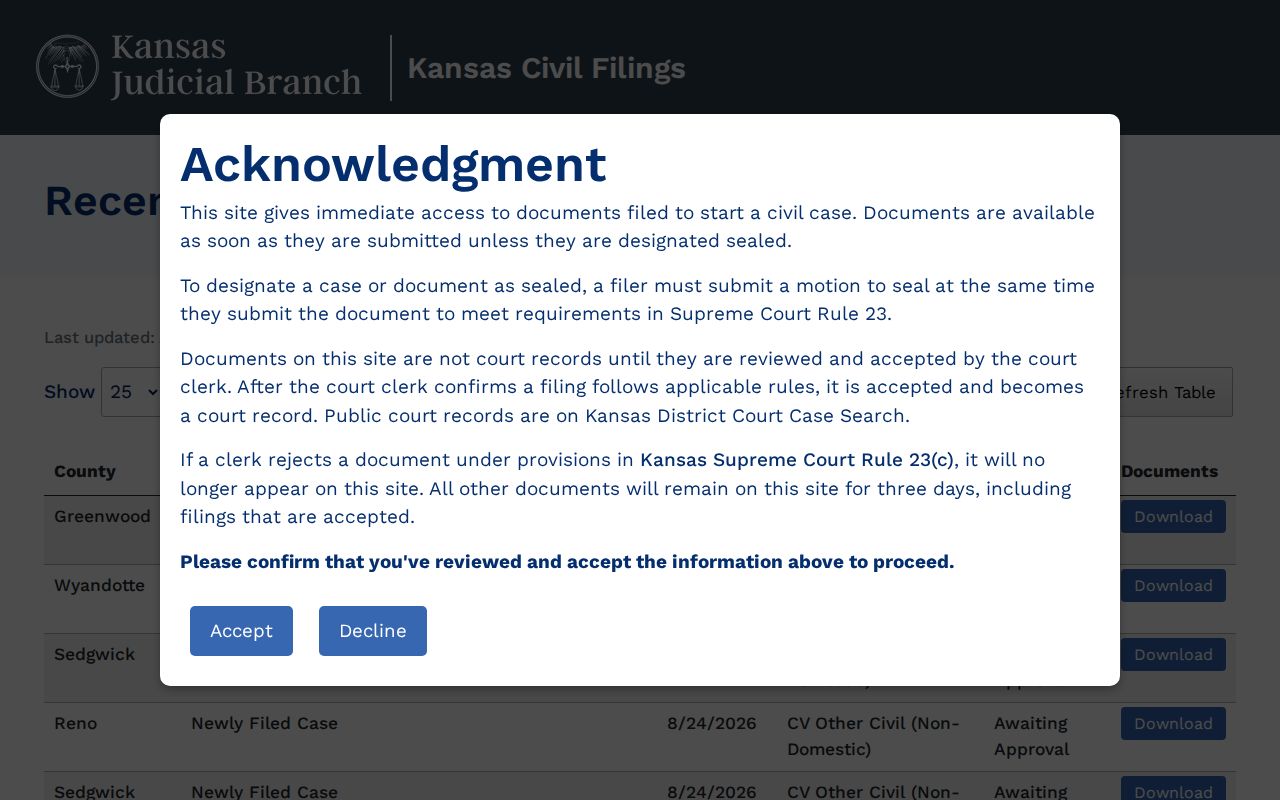
This screen stops at intake. It will not carry later motions, settings, or a judgment from the District Court, so a searcher still needs the case view or the clerk's record for those. Kansas keeps appeals in a different place entirely, on a separate appellate public portal.
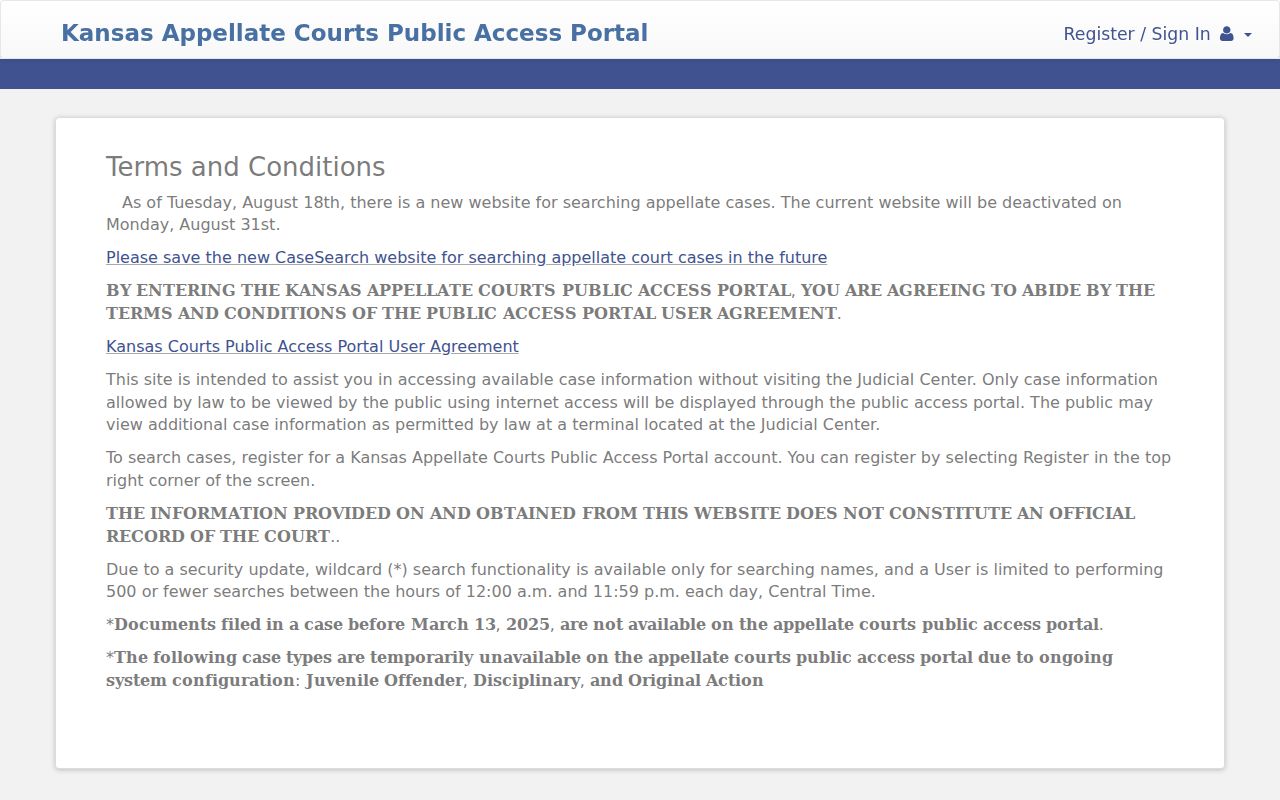
A Hodgeman district civil case stays in CaseSearch unless appellate activity opens a separate higher-court record.
Hodgeman Civil Records Fallback
When a public filing never shows up online, go to the clerk. The counter sits at 500 Main Street in Jetmore. The public terminal is there too. The phone is 620-357-6522. Mail can go to P.O. Box 187, Jetmore, Kansas, or by fax to 620-357-6216. The office publishes no current email, drop-box, copy-payment, or turnaround details. Confirm those before you submit anything.
For a records request, the Judicial Branch KORA form asks you to describe the record. It also asks how you want it delivered. Include the case number, the case type, the document title, and the date range. Say whether you want inspection, a plain copy, a certified copy, or a filed document.
Who Can See Civil Dockets
Plenty of civil docket entries are public, yet the portal holds some of it back. Domestic, protection, juvenile, probate, mental-health, and similar sensitive types may be excluded or restricted. Older converted documents can also sit off the web without being sealed, so ask the clerk which situation applies.
Key Rules:
Supreme Court Rule 22 controls public electronic case records and events indices.
Supreme Court Rule 24 protects personal identifiers in filed records.
Kansas Open Records Act provisions cover policy, written requests, exemptions, and use limits.
A courthouse terminal can surface public material the web withholds. It cannot unlock a sealed or nonpublic file.
Exclusion can happen at the case level or the document level. Domestic, protection, probate, juvenile, and mental-health categories may carry statutory or rule-based limits. Older converted filings, though, may simply lack web-visible images. The first case calls for respecting the restriction. The second may still allow inspection at the Jetmore terminal. The clerk can point to the right route. It will not reveal protected content.
Hodgeman Copy Request Details
A civil copy request works best in two parts. Separate the docket's events index from the document behind an entry. Give the case number, the CV or LM type, the filing date, the document title, and the date range. Say whether you want inspection, a plain reproduction, or a certified copy. That detail lets the clerk locate the record fast. It also helps estimate the cost.
Whole files take longer because each document can carry its own access limits. Hodgeman District Court posts no current copy prices or payment methods. Check with the clerk before sending any payment.